
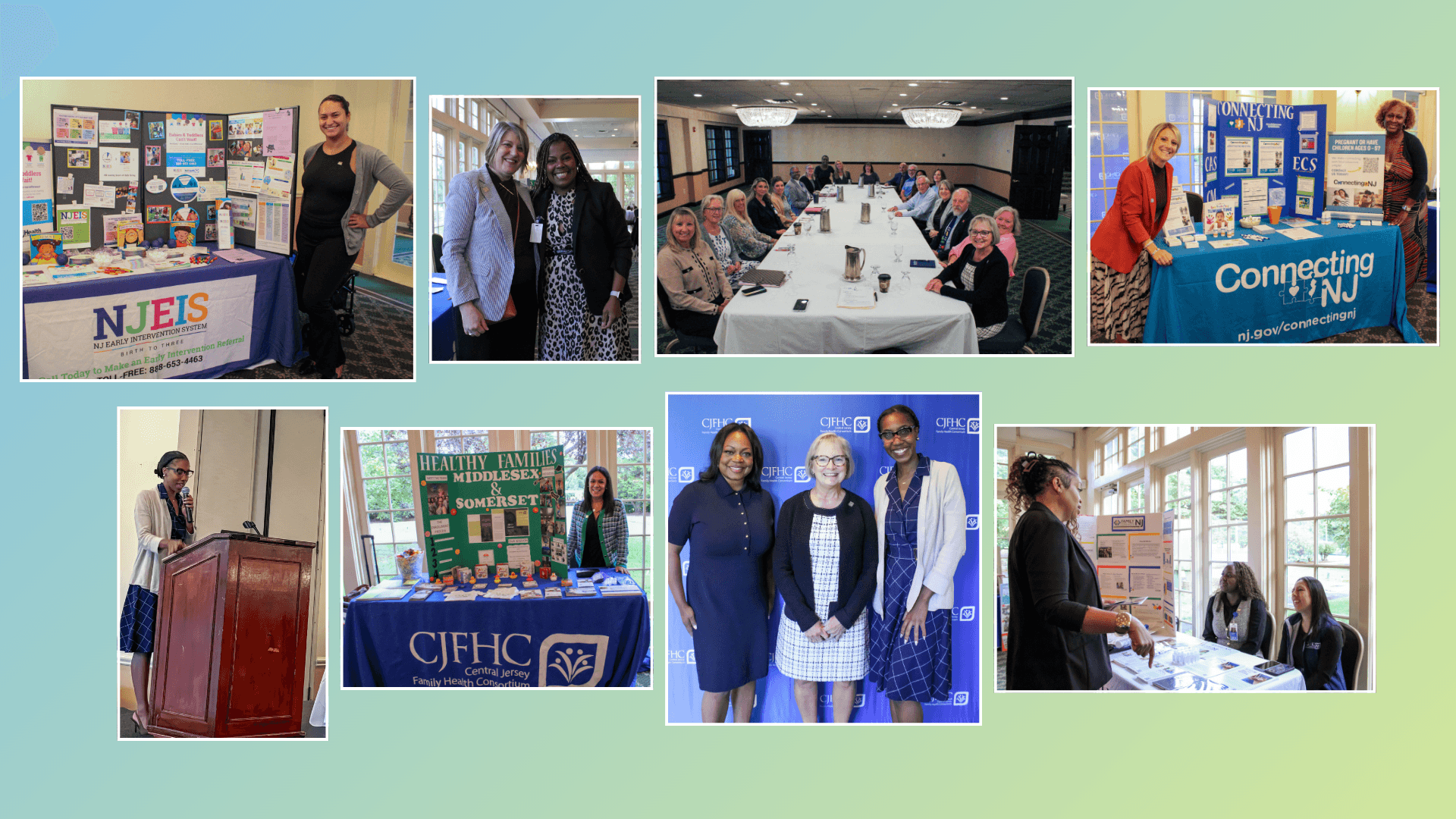
On September 16, 2026, Central Jersey Family Health Consortium (CJFHC) welcomed partners, community leaders, maternal and child health professionals, and colleagues from across New Jersey to its Annual Meeting at Forsgate Country Club.
The annual gathering provided an opportunity to reflect on the progress being made across New Jersey’s maternal and child health landscape, celebrate milestones, and look ahead to how stronger partnerships and community-centered approaches can help families thrive.
Updates on Maternal and Infant Health in New Jersey
Pamela Taylor, MPH, Collaborative Program Manager for the New Jersey Maternal & Infant Health Innovation Authority (MIHIA), provided an update on the work of MIHIA and the Maternal & Infant Health Innovation Center (MIHIC).
Her presentation highlighted ongoing efforts to strengthen maternal and infant health across New Jersey, the importance of collaborative work within MIHIA that is shaping the future of care, and the importance of collaboration, innovation, and community partnerships in improving outcomes for families. She also gave updates on Family Connects NJ, New Jersey's universal home visiting program for newborns, including an exciting milestone: the program has now served its 6,000th baby.
Family Connects NJ provides a universal, voluntary nurse home visit to families following the birth of a baby. During these visits, nurses connect families with information, support, and community resources based on their individual needs. Reaching 6,000 babies represents an important milestone for the program and reflects the growing reach of a model designed to bring support directly into families’ homes.
Bringing Care Closer to Home
The meeting’s keynote address was delivered by Kim Smith, CEO of Health Evolve Technologies, who joined CJFHC from South Carolina to share her personal story, professional experience, and vision for community-integrative care.
Her keynote, “Back Home Again: Centering Innovative Community-Integrative Models of Care for Better Outcomes Beyond the Walls of Systems,” asked attendees to consider a fundamental question:
What happens after a family leaves the appointment, the hospital, or the program? Who continues the care at home? Is there someone to notice if something is wrong? Do families know who to call? Will the mother believe someone will answer?
Smith shared her own experience of losing her daughter, Lauren, during pregnancy after developing HELLP syndrome. This devastating experience is what lead her to realize that while clinicians provided critical care during the crisis, it was her community that continued to support her after she left the hospital. "Medicine can intervene, medicine can operate, medicine can stabilize, but community stays. And I know the difference because I needed both. As you can imagine, I needed clinical skill in hospitals with my nursing team. I needed people who could sit with me when there really was nothing left to say."
That experience shaped Smith’s work and her commitment to building models of care that extend beyond traditional healthcare settings.
From Walls to Webs
We should not have to depend on a family's extraordinary persistence to make ordinary connections in care.
Throughout her keynote, Smith repeatedly brought up the analogy of walls and webs to describe the maternal health systems that provide care and how to successfully rebuild them with a community integrative approach. "We traded webs for walls." She said, referencing the current systems, "We became very very good at defining what happens inside an institution. We build expertise, protocols, specialists, the systems that can do extraordinary things. But a woman has to move between those places. Her life does not pause at the boundaries of our services.”
Those protocols, specialists, and processes stop at the door, echoing a sentiment many maternal health professionals and advocates in New Jersey have voiced: that maternal health often feels like a silo where professionals operate in their own zones, and the mothers move between them."Think of community as a web," Smith said, "A web of support surrounding a family. Clinical care remains essential, but so are the trusted relationships, community organizations, navigators, doulas, home visitors, family members, and other people who help families navigate life between appointments."
For Smith, community-integrative care means bringing all of these pieces together so families do not have to navigate complicated systems on their own. "I'm asking us to design something that works from a continuity perspective. Can the clinical plan travel home with a woman in a way where she can actually use it? Can someone help her make sense of it? Can a concern travel back to the right person at the right time?" As a community of maternal health professionals, can we break the walls currently built around our systems of care, and look at data while remembering the people and experiences behind the numbers? A statistic can describe an outcome, she explained, but it cannot tell us everything about what happened along the way: who listened, who was available, where a family found support, or where a connection may have broken down.
She encouraged attendees to use data as a starting point for asking better questions about the conditions surrounding pregnancy and birth—including transportation, housing, food security, employment, education, safety, and access to support.
Building Stronger Connections Across the Continuum
Smith recognized the many resources already available to New Jersey families and highlighted the important role of organizations like CJFHC and programs like Connecting NJ, Family Connects NJ, Healthy Families, postpartum and feeding supports, bereavement resources, and fetal and infant mortality review efforts. The opportunity, she suggested, is to strengthen the connections between those resources.
If a family enters through one trusted organization, can that person help them reach the next resource? Does the next partner know they are coming? Does anyone know whether the family received the support they needed?
This idea reflects a central part of CJFHC’s work: bringing organizations and communities together so families can more easily find the resources, services, and support they need.
Technology Should Strengthen the Human Connection
As CEO of Health Evolve Technologies, Smith also discussed the role technology can play in extending care beyond traditional settings.
She shared examples from Health Evolve’s work in rural South Carolina with Lauren, a patient navigator application, where technology and connected devices are being used to help care teams monitor patients between visits and respond when concerns arise.
But she emphasized that technology itself is not the solution to rebuilding the web of community and support around pregnant women. Instead, technology should support the relationships and systems that are already working in a community. A blood pressure reading, for example, only becomes part of effective care when the right person can interpret it, respond according to an established care plan, and help the family understand what comes next.
Smith also challenged attendees to consider how artificial intelligence and other emerging technologies can be incorporated thoughtfully—with human-centered design, digital health equity, clear responsibilities, and accessible pathways to human support.
A Call to Strengthen the Web
Smith closed her keynote by inviting attendees to bring the conversation back to their own work. Rather than trying to solve the entire healthcare system at once, she encouraged everyone to identify one point where a family can lose contact or momentum—perhaps between an appointment and a home visit, between a referral and a first call, or between noticing a concern and knowing who is responsible for responding.
Her message was ultimately one of connection, accountability, and community.
“All of you are part of the village.”
The 2026 CJFHC Annual Meeting was a reminder that improving outcomes for families requires more than individual programs or organizations working independently. It requires strong relationships, shared responsibility, thoughtful use of data and technology, and a commitment to meeting families where they are.
As CJFHC and its partners continue this work across New Jersey, the challenge—and the opportunity—is to keep strengthening that web of support and bringing care closer to home.
Together, we can help build a healthier future for New Jersey families—one connection at a time.
